The press-fit corner bench
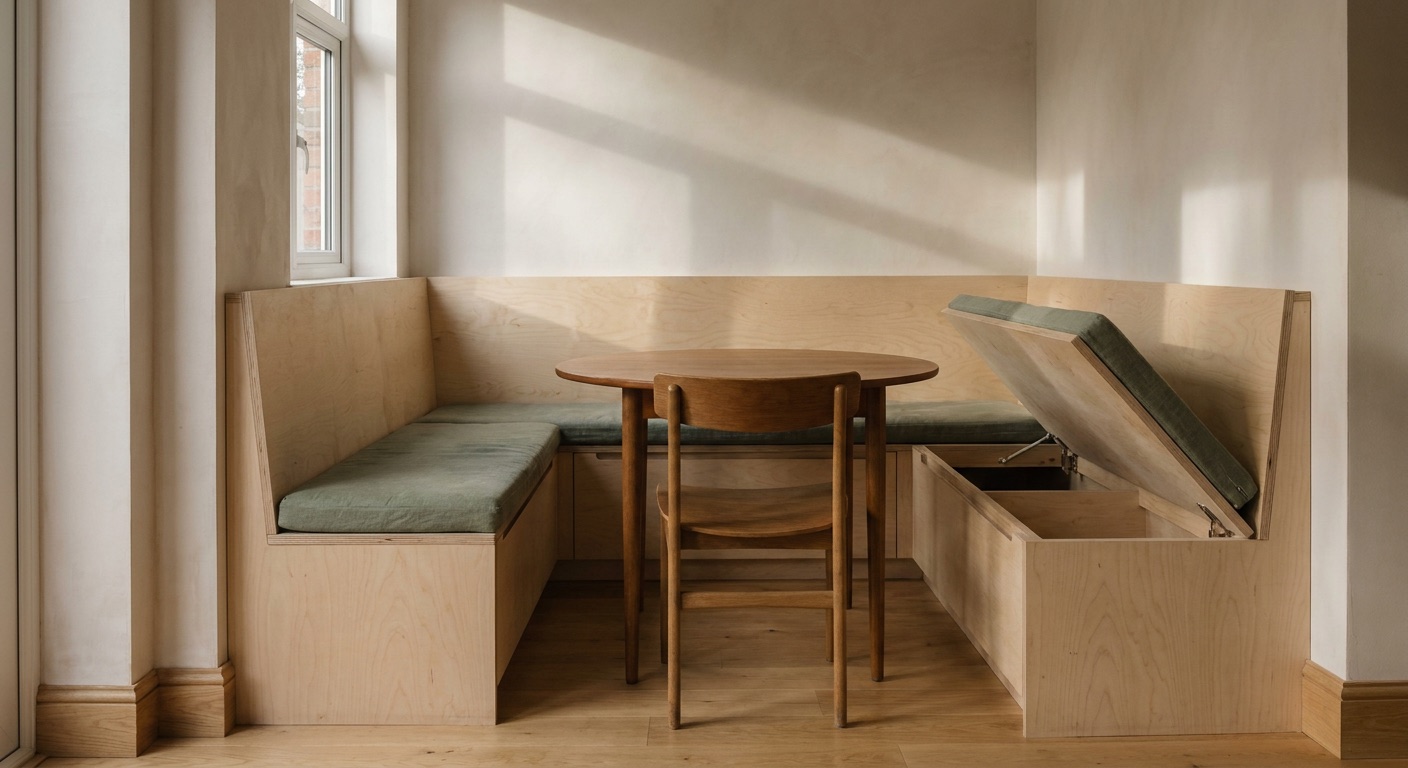
A corner bench with storage under every seat, cut from birch plywood and tapped together with a mallet. Here is how the joint works, how much it actually holds, and how to size one to your own corner.
Why a corner is the best seat in the room
A corner is dead space. Chairs cannot use it — you can only ever pull one up to a table, and the two walls behind it do nothing. A bench built into that corner turns the walls into backrests, seats more people in less floor than chairs can, and puts a cubic metre of storage under the seat that was not there before.
It is also the piece of furniture least likely to fit off the shelf. A corner has a skirting board, probably a radiator, possibly a socket, and two lengths that are whatever they happen to be. Made-to-measure is not a luxury here; it is the only thing that works.
The joint: tabs through slots, no screws
The usual way to build a plywood carcass is the housed dado: cut a groove partway into one panel and slide the edge of the next one into it. It locates the panel accurately and it does not hold. A dado is a shelf for the joint to sit on while the glue goes off, or while you drive a screw through it.
A press fit holds. The panel is cut longer than the space it fills, and the extra length is a row of tabs that pass right through the upright and finish flush with its outside face. The upright is notched straight through to receive them. Tap it home with a mallet and the panel cannot move along its own length, cannot lift, and cannot rack — because to do any of those it would have to shear a row of plywood tabs.
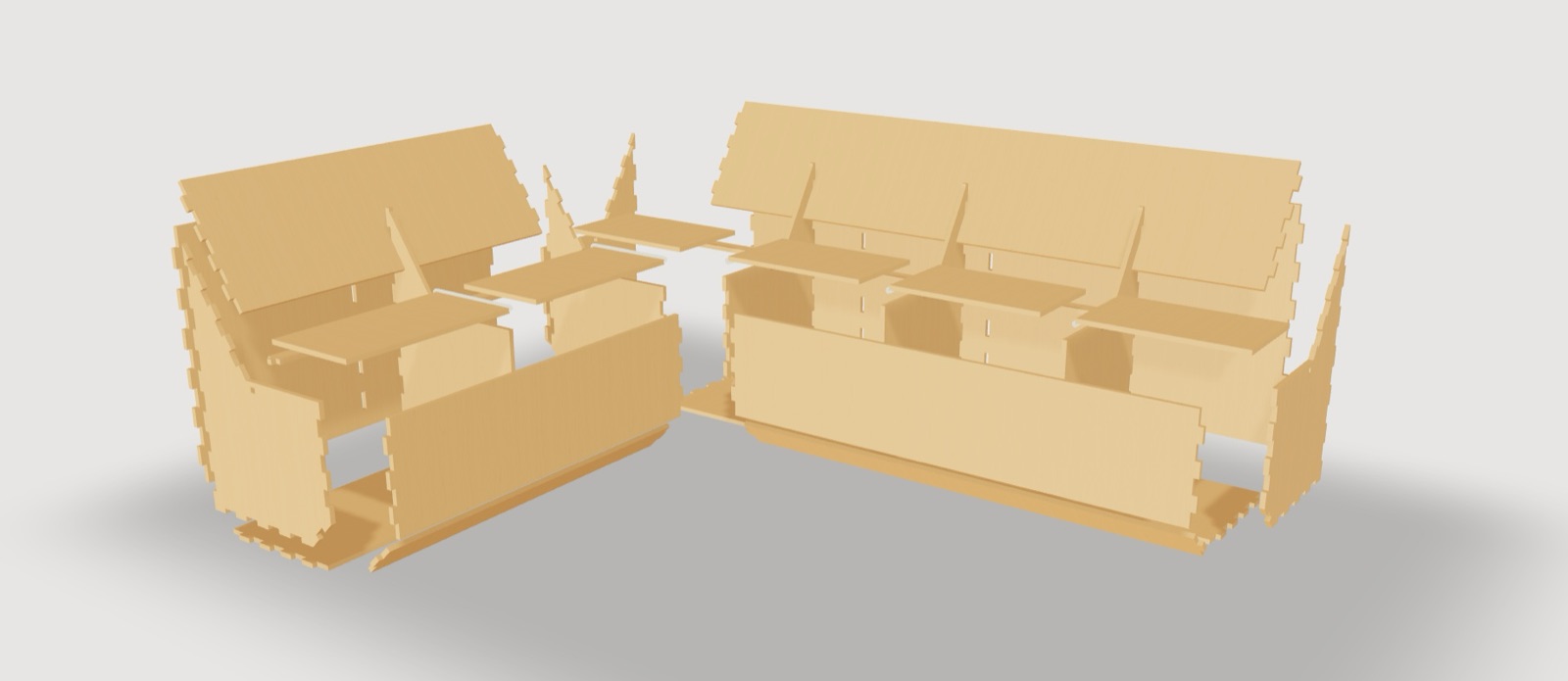
The consequences are worth spelling out, because they are the reason to build this way rather than a stylistic preference:
- No fasteners in the carcass. Nothing to work loose, nothing to strip out of plywood end grain, nothing to buy. The only hardware is a hinge per lid and a bracket or two into the wall.
- No clamps and no glue-up. A glued carcass this size needs more sash clamps than most people own and has to be square before the glue grabs. A press fit goes together dry, in a room, alone.
- It comes apart. Benches get moved. Tabs that were tapped in can be tapped out.
- The tolerance is the machine's, not yours. Every tab and every notch comes off the same CNC file, so they fit each other whether or not you can cut a straight line.
The trade is that it has to be routed. A panel saw cannot start a cut in the middle of a board, so a through slot is beyond it — this is a CNC job, and any workshop with a flatbed router can do it from a DXF.
The dimensions that matter
Four numbers decide whether a bench is comfortable, and only one of them is usually given any thought.
- Seat height, 440–480mm. A dining chair is about 460mm. Go higher and shorter people's feet leave the floor; go lower and getting out of it becomes a manoeuvre. If you are adding a loose cushion, take its compressed thickness off the timber height rather than adding it on top.
- Seat depth, 350–420mm. Measured from the backrest to the front edge, not the overall footprint. Deeper than this and you cannot get your back to the back without your knees leaving the seat.
- Backrest angle, 55–65° from horizontal. The one people get wrong. A vertical back is a wall, not a backrest. But every degree of lean eats seat depth, because the foot of the backrest moves forward as it reclines — which is why depth and angle have to be chosen together rather than one after the other.
- Overall depth, 600–700mm. Seat depth plus whatever the backrest lean has taken. This is the number that has to clear your table.
One detail earns its keep out of proportion to its size: a toe recess at the bottom of the front face, 100mm up and 100mm back. Without it you cannot tuck your feet under the seat as you stand, and the bench feels like a box you are perched on. With it, it feels like furniture.
How much it actually holds
The volume under the seat is the bench's real argument, and it is easy to underestimate. Take the seat height, subtract the board and the floor panel, and multiply by the seat depth and the run.
A 480mm-high bench with a 350mm-deep seat gives roughly 0.44m³ per running metre — call it 440 litres, or about five large storage boxes, in a metre of bench. An L-shape with a 2.2m and a 1.4m arm is over a cubic metre of storage that used to be a corner.
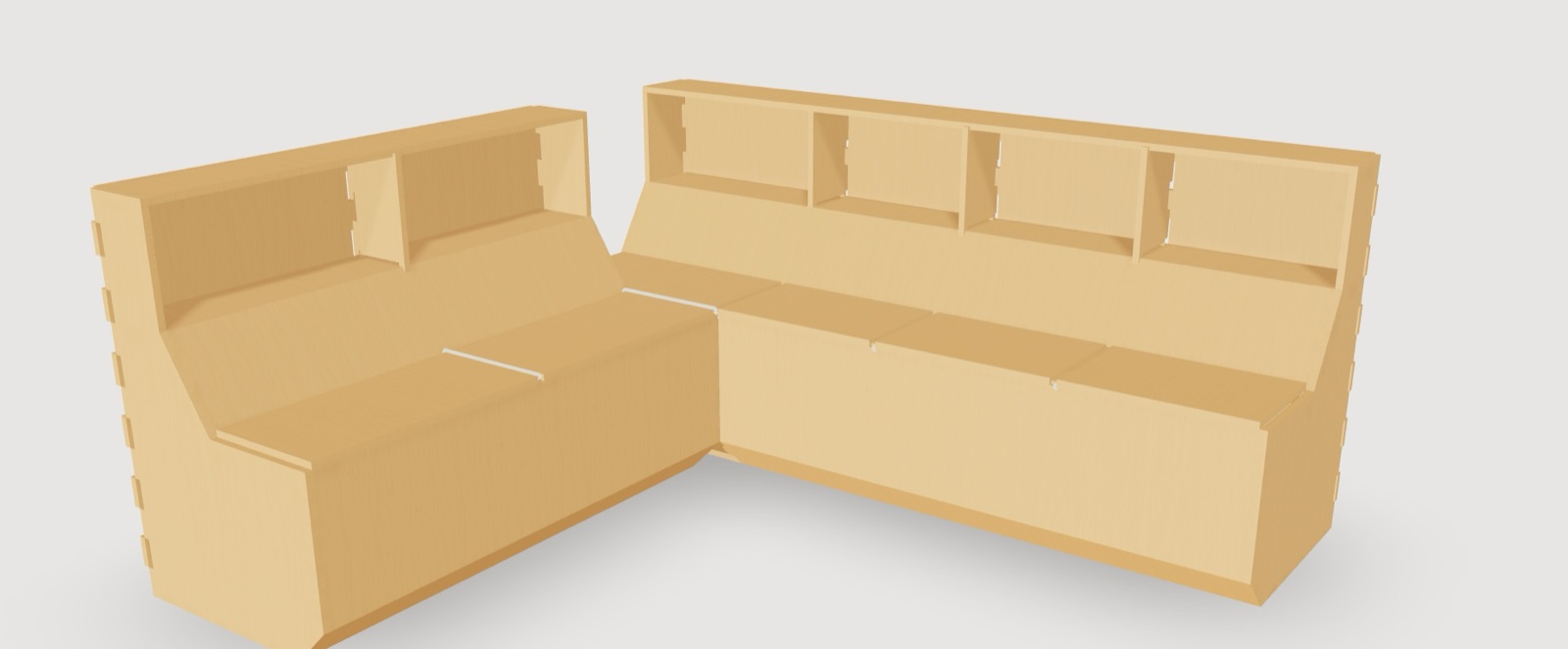
Divide the run into bays and give each one a lift-up lid on a piano hinge. Bays are not only about access: an unsupported plywood lid wider than about 900mm flexes underfoot, so a long bench wants three or four lids rather than one enormous one. The dividers between them are also what stop the seat deck bouncing.
If the backrest is tall enough, the space behind it can be opened up as well — a shelf across the top of the seat back, divided into cubbies, for books, jars and the things that otherwise live on the table. How deep that shelf can be is decided by the backrest angle, since it is only as deep as the back has leaned by the time the shelf cuts it off.
Material, and why 18mm birch
Birch plywood at 18mm is the right board for this and the reason is the joint. A tab has to be tapped through a slot and then take load in shear; below about 15mm the tab roots split instead of seating, and MDF crumbles at the shoulder rather than compressing. Birch ply has continuous plies with no voids, so a tab cut across them is genuinely strong, and the laminated edge is a finish in itself — no edge banding, nothing to peel.
A bench of the size above takes something in the region of eight 2440×1220 sheets. Clear-coat it and the ply edge becomes the detail rather than something to hide.
What it costs, and what it usually costs
Having a fitted banquette made is normally a four-figure commission. The pattern is familiar: a deposit to start the design, a conversation about your dimensions, drawings to approve, and a wait — because the expensive part is not the plywood, it is somebody drawing your corner by hand and then finding a workshop to cut it.
None of that work is difficult; it is just work, and it is the same work every time. Which is the whole reason this site exists. Set your two arm lengths and the four numbers above, and the design, the panel list and the price appear together — because the 3D preview, the cutting list and the quote are all reading the same set of panels. Then take the file to whichever cut-to-size workshop is nearest you.
The board and the machining are what they are wherever you buy them. What you are not paying for is the drawing.
Assembly
- 1. Lay the floor panels down where the bench will live and check the corner is square to the walls.
- 2. Stand the end uprights and the dividers into the floor, tapping each one until the tabs seat flush.
- 3. Drop in the front, the toe panel and the backrest. Work along the run rather than seating one panel fully before starting the next, or the last one will not go in.
- 4. Slide the back on last. It is what squares the whole carcass.
- 5. Hang the lids, then fix a bracket into the wall at each end. Nothing else is holding it to the house.
Use a dead-blow or rubber mallet with an offcut as a block. A steel hammer directly on a ply edge will bruise it.
- Board
- Birch ply 18mm
- Joinery
- Through tab
- Fasteners
- None in carcass
- Units
- Millimetres